

State agencies entered 2026 with a familiar challenge: rising expectations constrained by shrinking budgets. Agencies must deliver better services, move faster, and remain secure, all while operating with fewer resources. That pressure changes how states think about modernization. What was once positioned primarily as a long-term technology investment is now being evaluated based on its ability to deliver near-term operational and financial improvements.
Research from Pew shows that states are doubling down on efficiency and technology innovation as budgets tighten. This shift is already producing measurable results. Maryland, for example, modernized parts of its vehicle fleet operations and expects to save approximately $800,000 annually while Pennsylvania, having taken a similar approach, saved tens of millions of dollars.
States are no longer modernizing simply to replace aging systems. They are modernizing because efficiency has become a financial necessity.
Legacy Systems Are Standing in the Way
Many agencies are trying to improve efficiency using systems that were never designed for this level of demand. Insights from StateScoop show that states are shifting toward technologies like artificial intelligence to automate work and improve operational efficiency. At the same time, the National Association of State Chief Information Officers (NASCIO) continues to highlight digital services and cybersecurity as top priorities.
Legacy systems make that balance difficult. Financial data is often siloed, limiting visibility into spending and making it harder to identify fraud and waste. Manual processes slow reporting and force agencies to react to problems rather than prevent them. This lack of visibility and automation impacts both efficiency and experience. Without real-time insight into operations, agencies struggle to identify inefficiencies early, and staff are forced to rely on time-consuming, manual workflows.
Fortunately, legacy modernization can solve many of these concerns. For example, one Karsun team addressed this challenge with the development of a dashboard for one of our federal customers. By improving transparency the customer improved accountability across IT investments. By centralizing data and improving visibility into spending and performance, they could more easily track outcomes, identify inefficiencies, and make more informed decisions.
Cost Optimization Is Becoming a Strategic Priority
Agencies face another challenge with their aging systems. Legacy systems become more costly to maintain and increasingly difficult to support as expertise declines. The longer they remain in place, the harder it becomes to operate efficiently and respond to changing demands.
For many states, modernization is now directly tied to cost control. Rather than making broad changes all at once, agencies are focusing on improving financial visibility, reducing waste, and automating repetitive internal processes that consume time and resources. Modern systems enable this by providing real-time insights and reducing reliance on manual work, allowing agencies to manage resources more proactively. This shift also reflects growing pressure for accountability. As reported by StateScoop, political and budget constraints are pushing agencies to justify spending more clearly. Modernization, in this context, becomes a way to reduce costs while improving transparency.
A Shift Toward Measurable Results
States are also redefining how they approach modernization. Instead of large, multi-year efforts, agencies are prioritizing initiatives that deliver measurable outcomes such as cost savings and improved operational performance. As highlighted by both The Pew Charitable Trusts and National Association of State Chief Information Officers, modernization is increasingly tied to efficiency, not just innovation.
Moving Forward with Confidence
Cost optimization is only one part of the modernization story. Many states are also focusing on improving how services are delivered, recognizing that better experiences can also drive efficiency. We will explore this shift in more detail in the next blog.
Platforms like Karsun’s ReDuX help agencies better understand their systems, identify inefficiencies, and modernize in a way that reduces risk while improving visibility and control.
To learn how agencies are approaching modernization to improve financial performance, explore our latest case studies or connect with our team to discuss what that strategy could look like in your agency.
Promote Transparency is one of the three Ethical Governance Principles in the Federal Data Strategy. This 10-year vision statement drives agencies across the government to build better tools to bring valuable insights to decision makers and citizens. Nowhere is this clearer than in government dashboards and data visualizations which must clearly communicate complex information in a meaningful manner for their users.
Modernizing Legacy Dashboards

Leveraging its business intelligence and visualization expertise, Karsun recently engaged in such a dashboard modernization project with one of its government customers. This customer was charged with delivering a dashboard that provides insights to both internal stakeholders and key decision-makers outside the organization. The goal was to allow users to access the dashboard for data-driven decision-making while enhancing transparency and adhering to the Conscious Design principles outlined in the Federal Data Strategy.
An on-premise legacy application added complexity to the modernization project. Moreover, the previous dashboard was built by different vendors with a mix of features and functionality. As a result, Karsun’s customer needed to provide a new, user-friendly dashboard. It also strove to limit human error with the data submission and ingestion process while seeing a decrease in operations and maintenance costs. Using a modularized approach, the customer wanted one, coherent dashboard. The customer envisioned a streamlined data submission process while reducing the time required for making new data sets available and improving speed-to-insight.
Combining Design and Data Expertise
The Karsun Data Practice uses DataOps to bring together data platform and engineering with business intelligence and visualization expertise. In doing so, it worked with its customer to deliver a solution that not only used DataOps principles but also incorporated best practices for usability and visualizing data within the dashboard.
Working with the on-premise application and within the requirements set by another project partner, Karsun built the data objects. Backend microservices utilizing RESTful API fetched data from an API service call and prepared the visualization using the Python Plotly visualization library. Those visualizations are then delivered as a JSON object.
An additional component to dashboard modernization is user experience. The President’s Executive Order on Customer Experience compels the government to design and deliver services “with a focus on the actual experience of the people whom it is meant to serve.” As practitioners, this order draws the spotlight to a range of design methodologies intended to enhance transparency and the overall experience for all users.
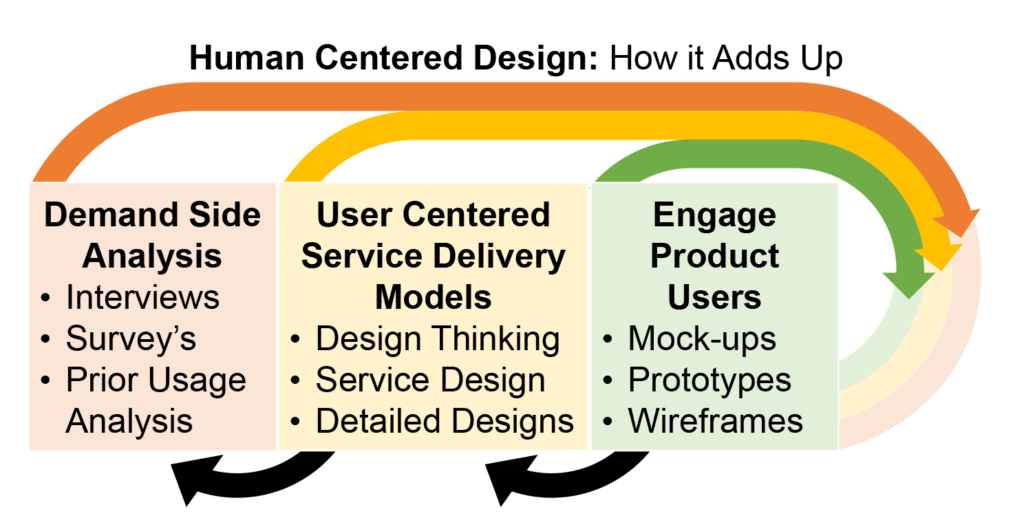
This project used human centered design (HCD), putting user needs, desires, and abilities at the center of the process. This also uses iterative feedback from each step to inform the analysis. Seeking clarity at each step, it transitions the dashboard away from a mixed experience that’s difficult for users to navigate and hard for the customer to maintain.
It uses a three step process. The first step is Demand Side Analysis. This engages users at the earliest opportunity through interviews and surveys. The team also conducts a Prior Usage Analysis. Next, they design a User Centered Service Delivery Model. This incorporates Design Thinking, Service Design, and Detailed Design. Finally, they again Engage Product Users by introducing Mock-Ups, Prototypes, and Wireframes. After iterating through these three steps, the team identified and built an application layer on a PHP/Drupal framework allowing for easy content manipulation without requiring technical knowledge.
User Friendly, Data Driven Insights at Lower Cost
This modernization project sunsetted legacy infrastructure and reduced high-cost maintenance. The new dashboard application further streamlined data collection, introduced omnichannel distribution of IT data, and improved the overall user experience. Moreover, by improving the process through human centered design, the customer improved the user’s ability to make evidence based decisions.
This project not only enhanced user experience it also supported requests for better data-driven decision making in government. While modernization projects frequently address high maintenance costs, human centered design adds an additional element. Improved user experience not only saves money, it enhances transparency, delivering better government to all.
This month we’re sharing success stories from our Data Practice. Follow us on LinkedIn for more insights. Check out our Data Solutions section for more from our Enterprise Modernization Experts.
About Karsun Solutions
 Karsun Solutions modernizes enterprise systems enabling agencies to make the next technological advancement their next opportunity to elevate mission capability. IT solutions from Karsun are tailored to meet agencies’ unique needs and optimize operations. These solutions adapt and stay relevant to current trends while using secure, digital architecture built to last. It is a proven modernization partner whose expertise elevates agency capabilities and ensures every next opportunity is within reach.